・:°.ೃ࿔⋆❀°“The land knows you, even when you are lost” °❀⋆.ೃ࿔*:・
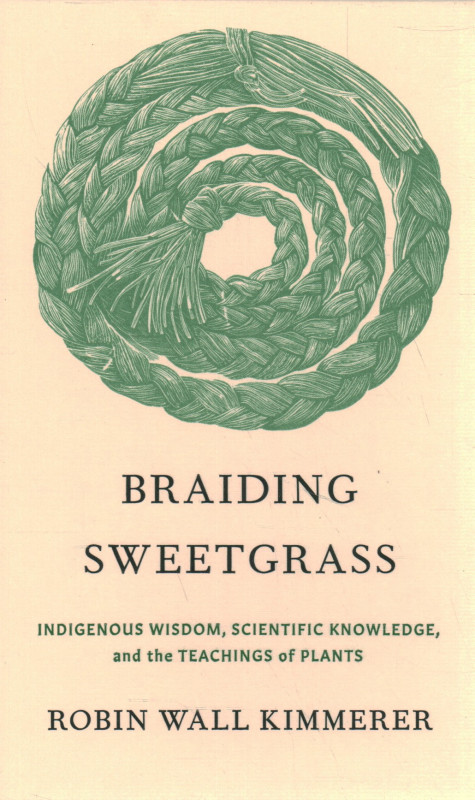
If there is a book that has changed my life, Braiding Sweetgrass by Robin Wall Kimmerer, is the one. A botanist and a member of the Citizen Potawatomi Nation, Kimmerer weaves science, story, and spirit into a collection of essays that discusses how to live in a world where everything is alive, everything is kin, and everything is owed our attention. I will discuss some of my favourite lessons from the book, but I beg you to get yourself a copy and read it front to back
━━━━━•°•°•❈•°•°•━━━━━
The grammar of animacy
Kimmerer writes that in the Potawatomi language of her people, most of the world is spoken of in the grammar of life. Potawatomi nouns and verbs are animate and inanimate, unlike the English “it” or “who”, or the masculine and feminine division in my mother tongue. Different verb form, plurals, and different everything else apply depending on whether what you are speaking of is alive.
In Potawatomi, rocks, mountains, lakes, water, fire, places, sacred medicine and songs are all animate. The list of what is inanimate is smaller, mostly filled with objects made by people.
Of an inanimate being, like a table, we say, “What is it?”And we answer Dopwen yewe. Table it is. But of apple, we must say, “Who is tht being?” And reply Mshimin yawe. Apple that being is.
A maple tree is not an “it,” but a “who.” The soil, the wind, the rain: they are persons too. And when the world is full of persons, our mode of being shifts from dominion to dialogue, from exploitation to reciprocity.
Unfortunately, the powers of assimilation pushed during colonial times made these Indigewnous languages with such grammar almost go extinct. After all, once you see nature as part of the family of beings as you, you can’t exploit it for profit. Perhaps learning the grammar of animacy could restrain our mindless exploitation of the environment.
While it would be irrational to suggest a complete overhaul of every language to fit this mold, we can still take steps to change our mindset towards appreciating our kinship with the rest of the animate world in a different way. A great example of this are the legal rights to nature some countries have established.
━━━━━•°•°•❈•°•°•━━━━━
The three sisters
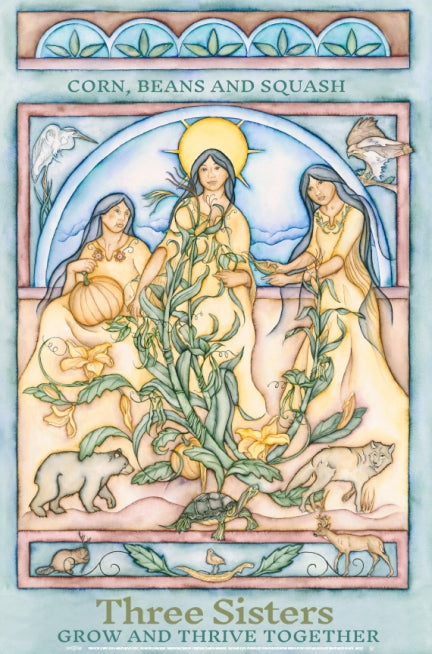
Corn, beans and squash. Their title of the “Three Sisters” comes from the Haudenosaunee. Different communities have stories, but the common thread is that their way of growing together is a lesson on how to live in reciprocity.
For centuries, Indigenous communities across Turtle Island have planted these three together in shared soil. Corn stands tall, reaching for the sun. Beans climb her sturdy stalk, twining upward with gratitude. And squash spreads wide at their feet, her broad leaves shielding the ground, keeping moisture in and weeds out.
Kimmerer calls this a symbiosis of sustenance. Each sister gives something the others need: structure, nitrogen, shade, protection. But more than that, each one makes space for the other to thrive. Together, they remind us that survival does not require sameness. That we live best when we grow in relation. That the most resilient systems, ecological and social, are those rooted in diversity, cooperation, and care.
━━━━━•°•°•❈•°•°•━━━━━
Windigo – and how to defeat it
One of the most haunting andd powerful ideas in Braiding Sweetgrass is Kimmerer’s telling of the Windigo, the monster from Anishinaabe stories who’s not born evil, but becomes that way through unchecked greed and selfishness. The Windigo isn’t just a tale to scare kids on winter nights, it’s a mirror held up to our worst tendencies, especially in a world that glorifies endless growth, consumption, and individual gain. Kimmerer shows how the Windigo lives on in modern economies that create artificial scarcity and hoard abundance, leaving others to starve.
But she also offers a kind of hope: that gratitude, sharing, and the wisdom of the commons are how we weaken the Windigo’s hold. It’s not just about changing systems, she says, it’s about changing hearts.
Here is the arrow that weakens the monster of overconsumption, a medicine that heals the sickness: its name is plenty. In winter, when scarcity is at its zenith, the Windigo rages beyond control, but when abundance reigns the hunger fazes away and with it the power of the monster.
Leave a Reply