
This is an essay I wrote for my Urban Political Ecology class, for which we were tasked to exemplify how Amsterdam’s wealth was built (and is maintained) through local and global relations of environmental exploitation (past and present). The example I chose was the BIjlmer neighbourhood, as I had become fascinated by its history after working there and watching this youtube video.
Thus my goal was to explore how the Bijlmer is a microcosm of the social and environmental relationships that shape the city of Amsterdam, and it made me realize how many places that are part of my everyday life relate to these complex and global phenomena.
It is important that we make light of these relationships because this knowledge fertilizes the ground that allowds for new ideas to grow. By knowing that the Bijlmer’s reputation comes from the fact that Surinamese migrants were pushed to populate it, you can make the conscious choice to not uphold this idea. It is through the knowledge of the architectural choices made during the Bijlmer’s construction that we realize what a neighbourhood needs in order to promote social relations.
Draining Lakes to Build Empires
The Environmental Legacy of Amsterdam in the Bijlmer and Beyond
Introduction
The Bijlmer neighbourhood’s high-rise buildings contrast the historic homes of the Amsterdam city centre. The two also differ in reputation: while Amsterdam boasts a reputation for wealth, progress, and innovation, the Bijlmer neighbourhood has a reputation for urban despair and neighbourhood decline (Aalbers 2010). Underlying these differences is a complex web of environmental exploitation and social inequities that underpin Amsterdam’s prosperity, which will be explored in this article. I will first discuss the history of the Bijlmer and explore how it is built on the appropriation of nature, relating it to Amsterdam’s colonial past. Then, some grassroots initiatives in the neighbourhood will be examined to show a possible way to mitigate past and ongoing environmental exploitation.

History of the Bijlmer
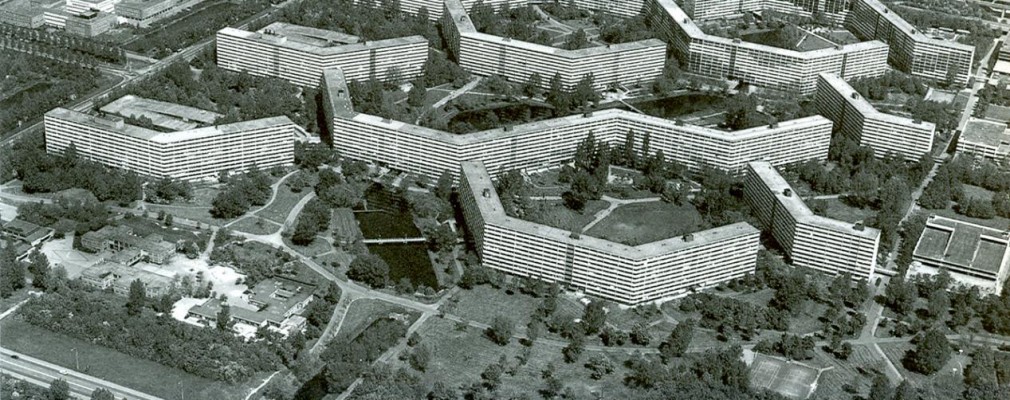
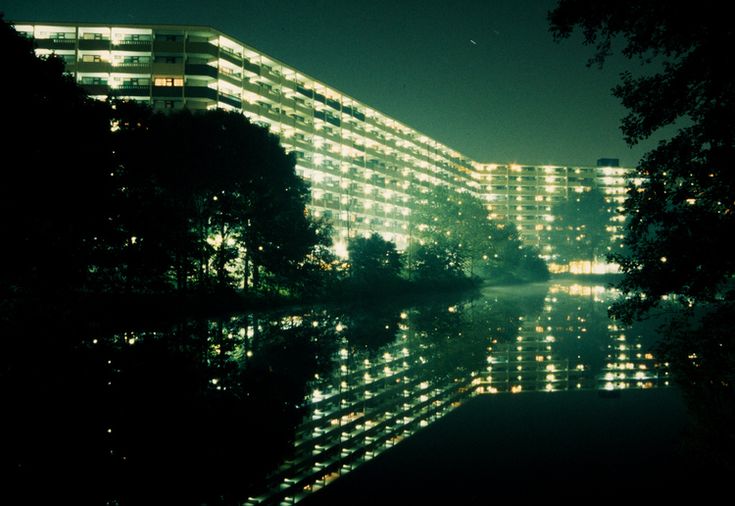
The case of the Bijlmer exemplifies how the Amsterdam city demands the metabolic and social transformation of nature for its expansion and wealth accumulation (Kaika 2012). Named after the former Bijlmermeer lake, the area reflects the city’s historical manipulation of landscapes, as the lake was drained in the 1620s for population growth and grain production, only to be refilled and redrained repeatedly based on urban demands (Amsterdam Cultural Historical Association 2023). The Amsterdam of the 1960s once again relied on Bijlmer to fulfil its expansionist plans, which lead to 30 hectares of grassland being expropriated and raised with 11,500,000 cubic metres of sand (Amsterdam Cultural Historical Association 2023). The area was promoted as a modernist dream: honeycomb buildings with park-like spaces between them and elevated traffic flow (Wassenberg 2021). However, the modernist architecture created dangerous blind spots instead of cosy spaces, fostering pollution, degradation, vandalism, and lack of safety. Moreover, the envisaged inhabitants, middle-class families, wished to stay in the more classical Amsterdam homes. Because of the 30% turnover rate, the dwellings were allocated to the thousands of recently arrived Surinamese migrants (Wassenberg 2021).
Colonial past: exploitation, migration, neglect
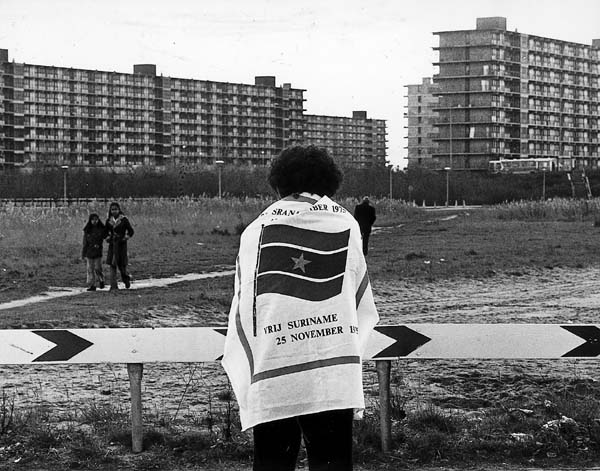
Closely linked to the expansion of Bijlmer is the accumulation of wealth and environmental exploitation driven by Dutch colonial enterprises, both fuelled by the call for growth. Forty years after draining Bijlmermeer, the Netherlands used similar methods to transform Suriname’s swamps into plantations for sugar, coffee, and cocoa (Suriname View 2018; de Bivar 2022). Mining for gold was also carried out by the Dutch, the activity which posed – and still poses – the largest threat of deforestation (Suriname View 2018; Collins 2020). Alongside environmental exploitation, African people were trafficked to work on these plantations and mines (Suriname View 2018), and their descendants migrated to the Bijlmer after Suriname gained independence in 1975. They faced a continuation of environmental inequality, as the absence of the intended middle-class white residents led to reduced investment and negative media portrayals, which exacerbated the problems of the neighbourhood (Wassenberg 2021).
Today’s Bijlmer
This history still lends Bijlmer the reputation of the only “Dutch ghetto”, even though its reality has much improved (Aalbers 2010). The area is safer and part of Amsterdam’s circular economy programme, and grassroots initiatives are revitalizing its green spaces, once blamed for facilitating crime (Mazzarella and Remoy 2021; Wassenberg 2021). Residents of Kleiburg building formed neighbourhood ties and care for a shared urban garden, while the VBAZO Project in the K-buurt has created an urban food forest, fostering community ties, safety, and biodiversity (VBAZO, n.d.). In the H-buurt a Community Land Trust (CLT) association is also fomenting the relationship between residents between each other and the neighbourhood by giving them a voice in rules about, among other things, allocation policy and sustainability (CLT H-Buurt, n.d.). With 80% of the Bijlmer now comprising green and public spaces, such initiatives are helping to address its legacy of environmental exploitation and are viewed by residents as the area’s greatest asset (Nieuwe Instituut 2021).

Two sides of a coin: continued environmental exploitation
While community organizations have improved the conditions of the Bijlmer, it is not enough to compensate for the past and ongoing environmental degradation caused by Amsterdam. Locally, there is still a lack of policies that increase security, make the living environment more sustainable, and promote democratization (Mazzarella and Remoy 2021). Moreover, the revitalization projects in the Bijlmer spurred a kind of “black gentrification”, in which middle-class Dutch Surinamese now live where those on the lower end of the city’s society were expelled (Aalbers 2010). At the global level, the extractive practices of Amsterdam’s colonial past have created a legacy of exploitation and inequality in Suriname. The extractive nature of Dutch colonization has led to poor institutional capacities in the country, which makes Suriname especially vulnerable to illegal loggers and miners (Murshed 2023). Moreover, Amsterdam also engaged – and still engages – in atmospheric colonialism. The city appropriated the atmosphere to make its wealth based on CO2 emissions, while Suriname will bear stronger impacts of climate breakdown even though it is carbon-negative due to its 92% forest cover (Hickel 2020; Global Forest Watch 2024).
Conclusion
In the remaining honeycombed buildings and modernist green spaces in Bijlmer, all these processes of appropriation, exploitation, and inequality have been absorbed. While community-led initiatives have significantly improved the area’s conditions, they fall short of addressing the systemic injustices rooted in both local neglect and Amsterdam’s colonial legacy. Locally, there is a pressing need for policies that ensure security, sustainability, and genuine democratization of urban spaces. Globally, the extractive practices of the Dutch colonial era continue to shape the vulnerabilities of Suriname, where weak institutions and environmental degradation persist.
Moving forward, the environmental impact of the community initiatives in the Bijlmer could be explored and promoted by the city. At the policy level, there should be a serious push towards lowering Amsterdam’s carbon emissions to stop the ongoing atmospheric colonialism to at least compensate for the environmental exploitation of the past.
━━━━━•°•°•❈•°•°•━━━━━
Bibliography
Aalbers, M. B. (2011). The Revanchist Renewal of Yesterday’s City of Tomorrow. Antipode, 43(5), 1696–1724. https://doi.org/10.1111/j.1467-8330.2010.00817.x
Amsterdam Cultural Historical Association (ACHV) (2023). Bijlmermeer. https://www.amsterdamhv.nl/wiki/bijlmermeer.html. Consulted on December 15 2024.
Chiara Mazzarella, P., & Remoy, H. (2021). Bijlmermeer and Scampia: The potential of suburbs as centralities in sustainable and circular cities. IOP Conference Series. Earth and Environmental Science, 855(1), 12022-. https://doi.org/10.1088/1755-1315/855/1/012022
CLT H-Buurt. (n.d.). CLT H-Buurt. https://www.clthbuurt.nl/home-english
Collins, Y. A. (2020). How REDD+ governs: Multiple forest environmentalities in Guyana and Suriname. Environment and Planning. E, Nature and Space (Print), 3(2), 323–345. https://doi.org/10.1177/2514848619860748
de Bivar Marquese, R. (2022). A Tale of Two Coffee Colonies: Environment and Slavery in Suriname and Saint-Domingue, ca. 1750–1790. Comparative Studies in Society and History, 64(3), 722–755. https://doi.org/10.1017/S0010417522000147
Global Forest Watch (2024) Data for Suriname. https://www.amsterdamhv.nl/wiki/bijlmermeer.html Consulted on December 15 2024.
Hickel, J. (2020). Less is more : how degrowth will save the world. Penguin Books.
Kaika, M. (2012). City of Flows : Modernity, Nature, and the City. Routledge.
Murshed, S. M. (2023). The resource curse. Agenda Publishing. https://doi.org/10.1017/9781911116509
Nieuwe Instituut (2021). Green in the City #2: the Bijlmermeer. https://nieuweinstituut.nl/en/events/groen-de-stad-2-de-bijlmermeer Consulted on December 15 2024.
Suriname View. (2018). History/Geschiedenis | Suriname View. https://www.surinameview.com/sranan/geschiedenis/ Consulted on December 15 2024.
VBAZO. (n.d.). https://vbazo.nl/en/. Consulted on December 15 2024.
Wassenberg, F., Harnack, M., Heger, N., Brunner, M., Harnack, M., Brunner, M., & Heger, N. (2021). Conservation or Replacement of Large Housing Estates? Experiences from Bijlmermeer, Amsterdam, the Netherlands. In Adaptive Re-Use (pp. 95–104). Jovis Verlag GmbH. https://doi.org/10.1515/9783868599510-010

Leave a Reply to Tiago Oliveira Cancel reply